You’re doing everything right. You’re taking your medication, attending your appointments, watching your diet. And yet your blood pressure won’t budge. Or you’re exhausted despite a full night’s sleep. Or your mood has shifted in ways that don’t quite add up. Or perhaps you’re not reaching your fitness goals or your work performance is just not what it used to be.
For a significant number of Australians, the missing piece is obstructive sleep apnoea — and they have no idea.

OSA is far more common than most people realise
Obstructive sleep apnoea (OSA) occurs when the airway repeatedly collapses during sleep, causing the body to partially wake in order to restore breathing. These episodes can happen dozens — sometimes hundreds — of times per night, fragmenting sleep and starving the body of oxygen, without the person having any memory of it in the morning.
The prevalence data is striking. Research suggests that approximately one in two men over 40 have moderate-to-severe sleep-disordered breathing. Yet OSA remains significantly underdiagnosed, partly because many people assume it only affects overweight, older men who snore loudly. In reality, OSA presents across a much wider range of body types, ages, and genders — and many people with significant OSA sleep through the night without their partner noticing anything unusual.

The conditions OSA may be driving — or making worse
High blood pressure that won’t respond to treatment
If you or someone you know has hypertension that isn’t responding well to medication, OSA is worth investigating. Each time the airway collapses during sleep, the body undergoes a stress response — heart rate rises, blood pressure spikes, and the sympathetic nervous system activates. Over thousands of episodes per year, this chronic nocturnal stress drives sustained hypertension that can be difficult to manage through medication alone.
Research has shown that successfully treating OSA can lead to meaningful improvements in blood pressure management — sometimes reducing the need for medication.

Heart failure and atrial fibrillation
The links between OSA and cardiovascular disease are now well established. Recent data highlights a significant gap in chronic disease management: up to 80% of patients with heart failure, and approximately 50% of those with atrial fibrillation, have undiagnosed obstructive sleep apnoea.
For patients already managing these conditions, the repeated oxygen desaturations that occur during untreated OSA place additional strain on an already compromised cardiovascular system. Identifying and treating OSA is increasingly considered part of comprehensive cardiac care — yet it is often missed entirely.
Type 2 diabetes and metabolic health
OSA is also considered a likely hidden variable in patients with type 2 diabetes that is difficult to manage. Night-time oxygen desaturation and disrupted sleep architecture affect insulin sensitivity and glucose regulation. For patients who are doing everything their endocrinologist recommends and still struggling to achieve good control, sleep-disordered breathing is worth ruling out.

Mood, cognition, and what gets mistaken for something else
This is perhaps the most underappreciated aspect of OSA — and one that disproportionately affects women.
Symptoms including persistent low mood, poor concentration, memory difficulties, irritability, and emotional flatness are frequently attributed to depression, stress, perimenopause, or simply the demands of a busy life. In a meaningful proportion of cases, these symptoms are driven — at least in part — by disrupted, non-restorative sleep caused by untreated OSA.
One of the key clinical distinctions is the difference between general tiredness and excessive daytime sleepiness. General tiredness — feeling fatigued and flat — is common and has many causes. Excessive daytime sleepiness — the inability to stay awake in passive situations, such as reading, watching television, or sitting in a meeting — is a more specific symptom of disordered sleep architecture and is worth taking seriously.
Brain fog, reduced vigilance, and difficulty sustaining attention also have real-world consequences. For professionals, this affects performance, decision-making, and productivity. For anyone who drives regularly, it is a genuine safety concern.

Why so many people go undiagnosed
OSA is underdiagnosed for several reasons. Many people don’t snore loudly, or sleep alone and have no partner to report disrupted breathing. Some people feel they sleep “fine” — they fall asleep easily and don’t wake frequently — without realising that their sleep is non-restorative at a physiological level.
Women in particular are less likely to be referred for sleep studies, partly because their symptoms more commonly present as fatigue, mood changes, and insomnia rather than the loud snoring and witnessed apnoeas more typically associated with male OSA.
And for people already seeing multiple specialists for chronic conditions, sleep-disordered breathing may simply not be on anyone’s radar.
What can be done — and where your dentist fits in
If you think OSA may be relevant to you or someone in your care, the starting point is usually a conversation with your GP and a referral for a sleep study. We can help arrange this for you. This may be an in-laboratory polysomnography or a home-based sleep test, depending on your circumstances and your physician’s recommendation.

If OSA is confirmed, treatment options include:
CPAP (Continuous Positive Airway Pressure) — a machine that delivers pressurised air through a mask to keep the airway open during sleep. It is highly effective but not tolerated by all patients. Mask comfort, noise, and the practical demands of travelling with equipment mean that adherence can be a real challenge.
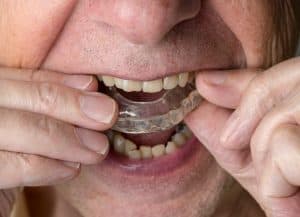
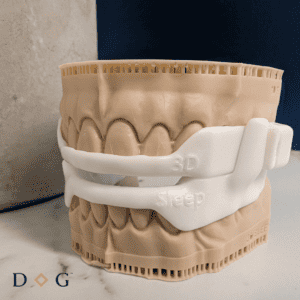
Mandibular Advancement Splints (MAS) — a custom-fitted oral appliance made by a dentist that works by gently repositioning the lower jaw forward during sleep, preventing the airway from collapsing. MAS therapy is recommended by sleep physicians as a first-line treatment for mild-to-moderate OSA, and as an alternative for patients with severe OSA who cannot tolerate CPAP.
At Dentistry on George, we provide custom-fitted MAS devices for patients who have been diagnosed with OSA or who are experiencing significant snoring. The device is made from digital scans of your teeth and fitted precisely to your bite. Most patients find it significantly more comfortable and convenient than CPAP, and many report noticeable improvements in daytime energy and alertness within the first few weeks.
Who should consider asking about OSA?
You may benefit from a conversation about sleep-disordered breathing if you:
- Snore regularly, or have been told you stop breathing in your sleep
- Wake unrefreshed despite what seems like adequate sleep
- Experience excessive daytime sleepiness — not just tiredness, but difficulty staying awake in passive situations
- Have high blood pressure that is difficult to control
- Have been diagnosed with atrial fibrillation or heart failure
- Are managing type 2 diabetes and finding it difficult to achieve good glucose control
- Experience persistent brain fog, poor concentration, or mood changes that haven’t responded to other interventions
- Are a woman whose symptoms have been attributed to perimenopause or stress

What to do next
If you think OSA may be relevant to you, the starting point is a conversation with your GP and a referral for a sleep study. We’d encourage you to take this route rather than going directly to a sleep study provider — and here’s why.
Not all sleep study providers are equal, and the pathway you take matters. Some providers are affiliated with CPAP suppliers and will recommend CPAP as the primary or only treatment option, regardless of whether other options might suit you better. For a dentist to provide a mandibular advancement splint (MAS) as part of your OSA management, MAS therapy needs to be specifically recommended or considered in your sleep physician’s report.
By starting with your GP, they can refer you to an independent sleep physician who will assess all appropriate treatment options for your situation — including MAS — and provide a report that opens the door to the full range of care available to you. We’re happy to suggest sleep physicians we work with regularly if that’s helpful.
If you’ve already had a sleep study but aren’t sure what your report says about MAS therapy, bring it along to your appointment with us and we can take a look together.
At Dentistry on George, we see patients in Brisbane CBD who are looking for practical, evidence-based solutions to sleep-disordered breathing — whether that’s snoring affecting a partner’s sleep, or OSA contributing to a broader health picture that hasn’t quite added up.
Call us on 0732111155 or book online to arrange a consultation.
Related reading: